Finding film
How I accidentally became a filmmaker and made our first $30,000 launch video.
This post is a reflection on the journey of how I got here, and how you never know what’s on the other side of something.
Audiograph
Before Shapeshift, I was an ambitious young founder trying to conquer the world. I had seen a lot of success at a previous startup, where I joined as the first employee, got acquired, and eventually even got listed in the public markets.
Whether it was out of ignorance or ego, I wanted to start my own company, and in the twenty-teens, I saw an opportunity in an emerging space called podcasting. This was pre-pandemic, so podcasters had yet to become household names.
Podcasts at the time were shows produced by media companies like NPR and Wondery, but I saw an emerging trend of domain experts casually talking to their friends. Lex Fridman was just a MIT professor interviewing other academics in their offices. Lenny Rachitsky was still writing blog posts about marketing on Medium and I remember watching episode one of Andrew Huberman’s show.
My first startup tried to create tools for podcasters — mainly focusing on transcription and clipping. These things are taken for granted today, but back then it was very hard and expensive. It cost us $50 per episode in transcription costs. We were too early at the time, and we ran out of money.
Cashflow
I needed cash so I started working with founders as a fractional product / growth guy, whatever I could get my hands on to avoid getting a job, and I saw another creator trend, this time on LinkedIn.
The platform seemed to be on the cusp of a content revolution.
It all started with Chris Walker, who posted clips of himself from webinars paired with templated copy — his own ideas, strongly stated and structured mostly as lists, a format LinkedIn seemed to love.
I was fascinated and began working with CEOs like Ethan Aaron, interviewing them, transcribing the clips, and rewriting them as LinkedIn posts to recreate the Chris Walker playbook.
It was magical.
I felt like I was riding at the head of a paradigm shift and I was cashflow positive for the first time ever.
I knew media platforms behaved like markets (it’s literally in the name and all content is marketing) but I had never experienced it for myself. As marketers saw opportunity on LinkedIn, they started copying the formats and began competing away the alpha.
I saw this and pivoted my clients Ethan Aaron and Matt Schulman toward video content, talking head specifically. This was an edge, because nobody knew how to operate cameras or mics, including myself.
It was rough at first, and I had to cut many deals, at times giving work away for free to convince CEOs that videos were worth doing, but we figured this out too.
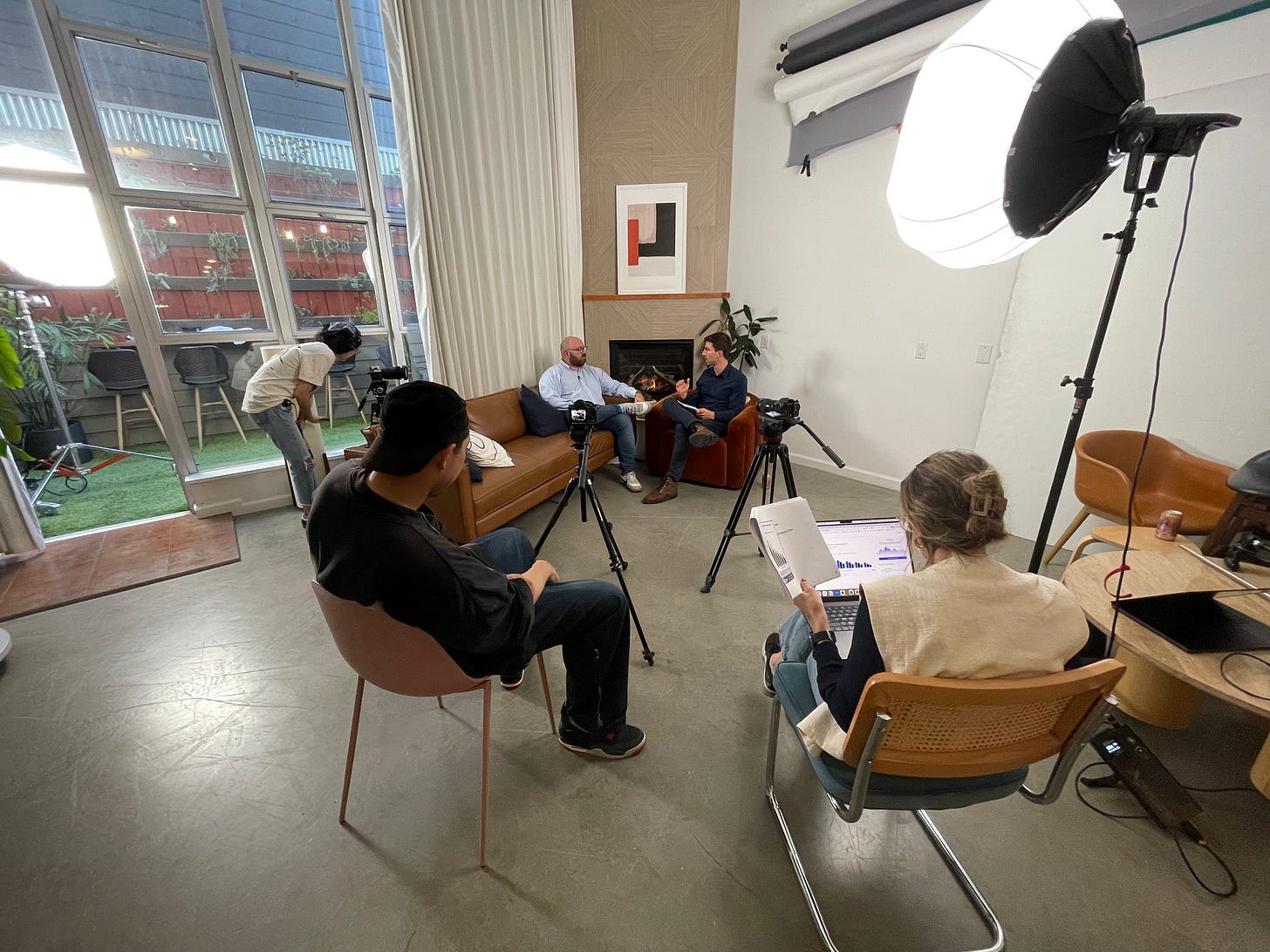
In 2025, we were hitting 500K impressions, even for niche compensation content, and turning LinkedIn videos into customer acquisition flywheels and then Claude came out.
It’s not your quest
I remember when the first wave of low cost LinkedIn ghostwriters started sending me connection requests, but when Claude Sonnet came out, that was the beginning of the end.
I’m deathly afraid of the Dead Internet Theory, because slop content changed the shape of my business. I saw what the business would look like at scale: low cost, high churn, factory farmed content by offshore writers.
It’s a repeatable model that, in some ways, has replicated itself to launch video businesses today.
The LinkedIn business ran between 60-80% gross margins, but LinkedIn content was slop before it was called slop, and the artist in me hated that I was producing this type of work. While I tried my best to be strategic for my customers and genuinely put out good thought leadership, at scale, the market didn’t want that.
Once again, I felt trapped and unfulfilled, doing work that felt meaningless, the same feelings that I’d felt as a burnt out corporate worker. But this time, I’d built a prison of my own making.
As the LinkedIn algorithm continued to erode and AI slop flooded the platform, I knew it was time to gradually pivot the business.
We’d already been doing video, but I had no idea how sets worked, or any sense of the culture and language of filmmaking. I’d initially hired Hailey as a freelance editor, but her role quickly expanded beyond cutting talking heads. In my naivety, I had Hailey do a bit of everything from directing and DP’ing on small sets, doing sound, file management, and everything in between.
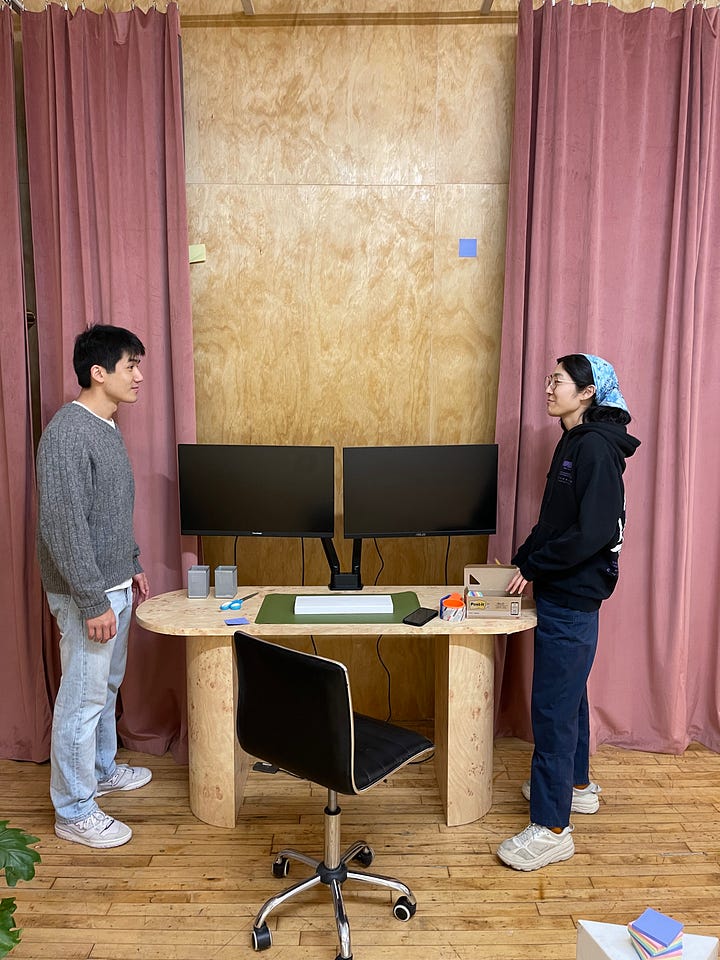
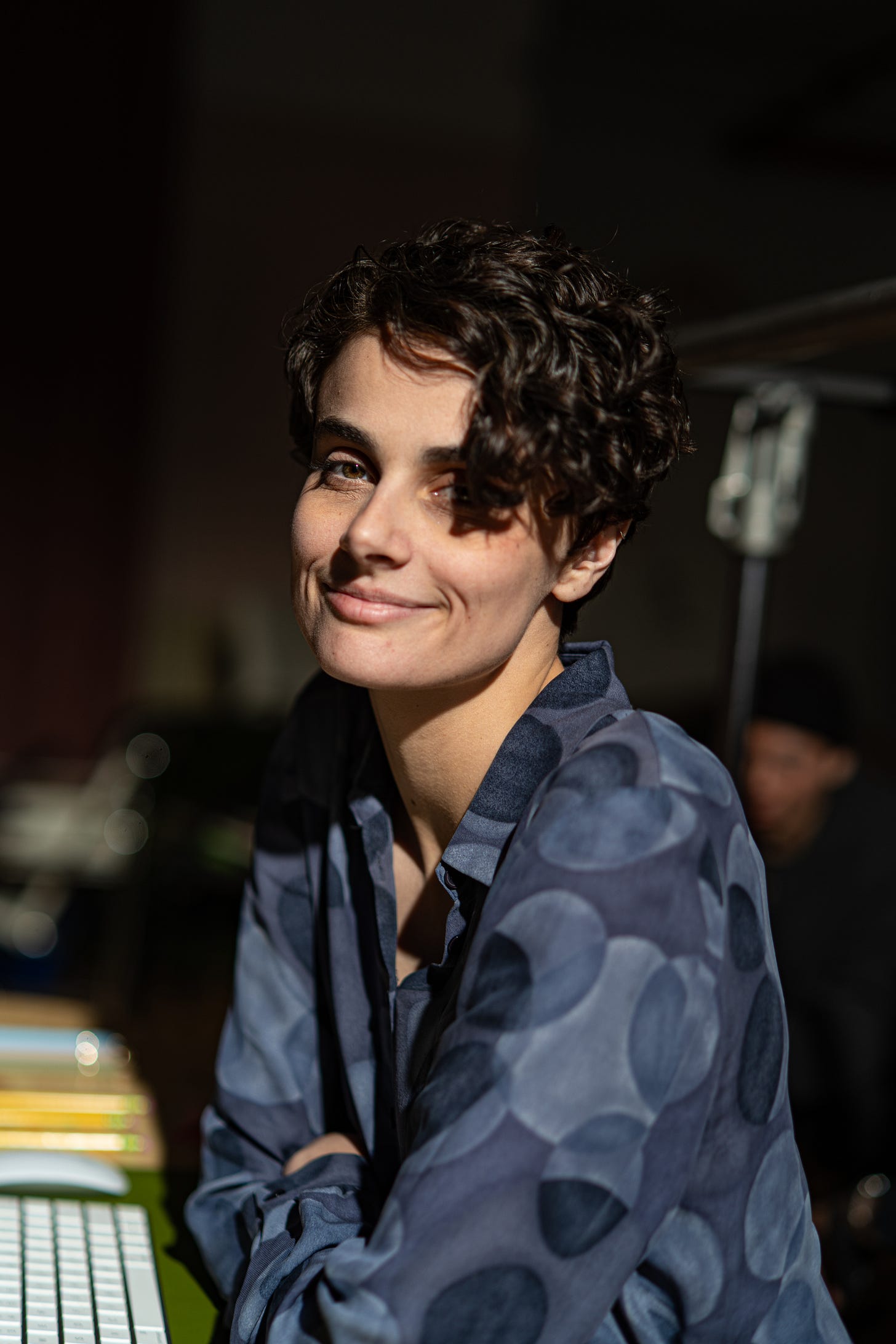
I’m so grateful to Hailey, because she introduced me to a whole new world. Hailey was taking a long needed break from working in media, where she was a permalance editor for Complex, but her true love was filmmaking. Through her, I slowly learned how things worked in production, each role on set and how specialized (and costly) talent was, and the cultural aspects of filmmaking, crafty, credits, community.
Hailey kept telling me we needed a producer. I’d been playing the role of making paper edits, interviewing customers, and organizing shoots all at the same time. In November, we hired Jamie from Legendary (Dune Part Two) and everything changed from here.
I owe Jamie and Hailey a lot for trusting me to pivot the entire business in 2025, and Jamie especially for buckling up on the ride that was the first 6 months of his job.
We did a lot of doc style work that I’m still proud of like DOBO. In February we had our first big break.
Enter Clint Dunn
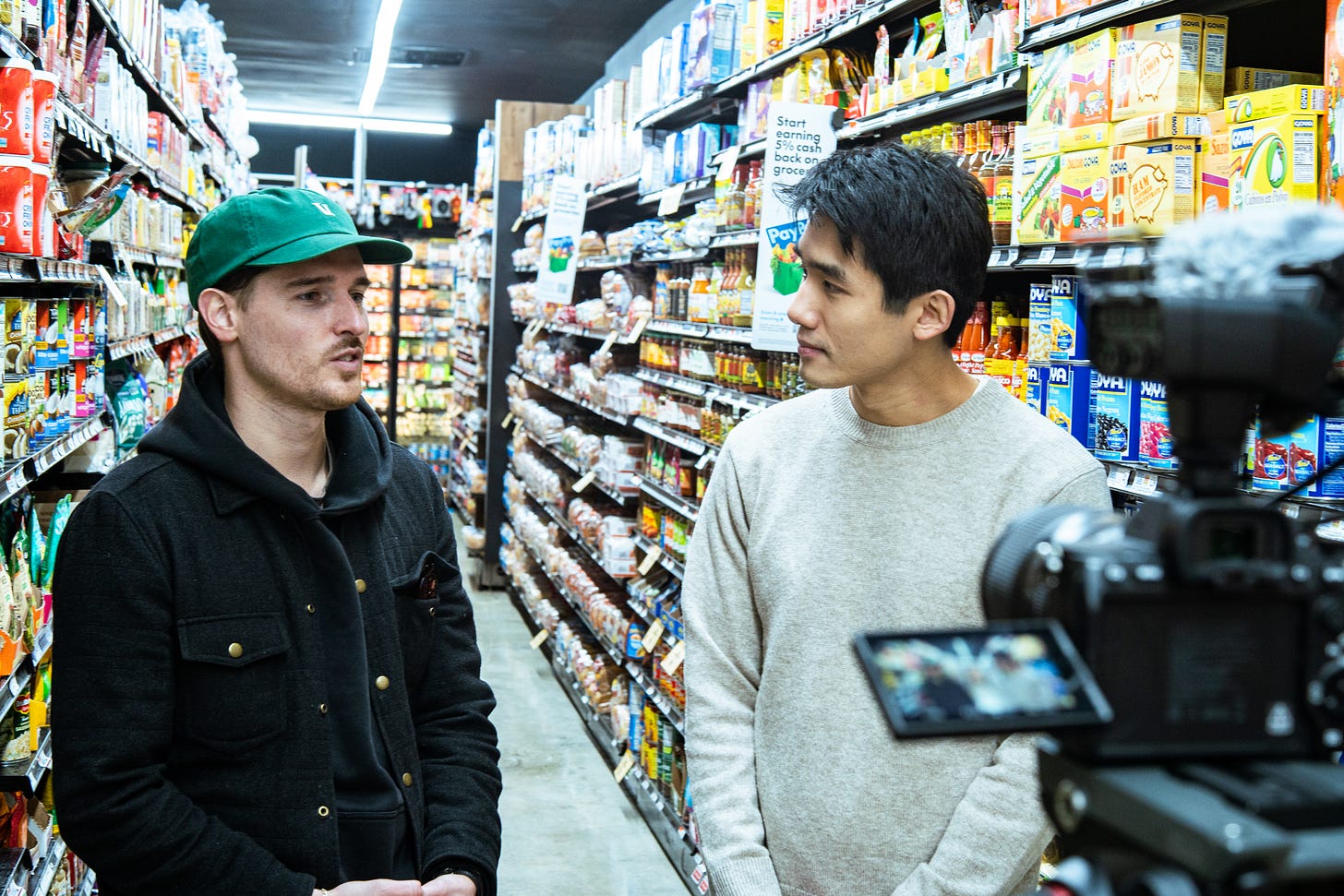
Clint was a friend that I’d met over LinkedIn but took years for us to finally work together. I’d always believed in playing the long game, but I could’ve never guessed an innocent DM would lead to a five-figure deal and my first true on-set filmmaking experience.
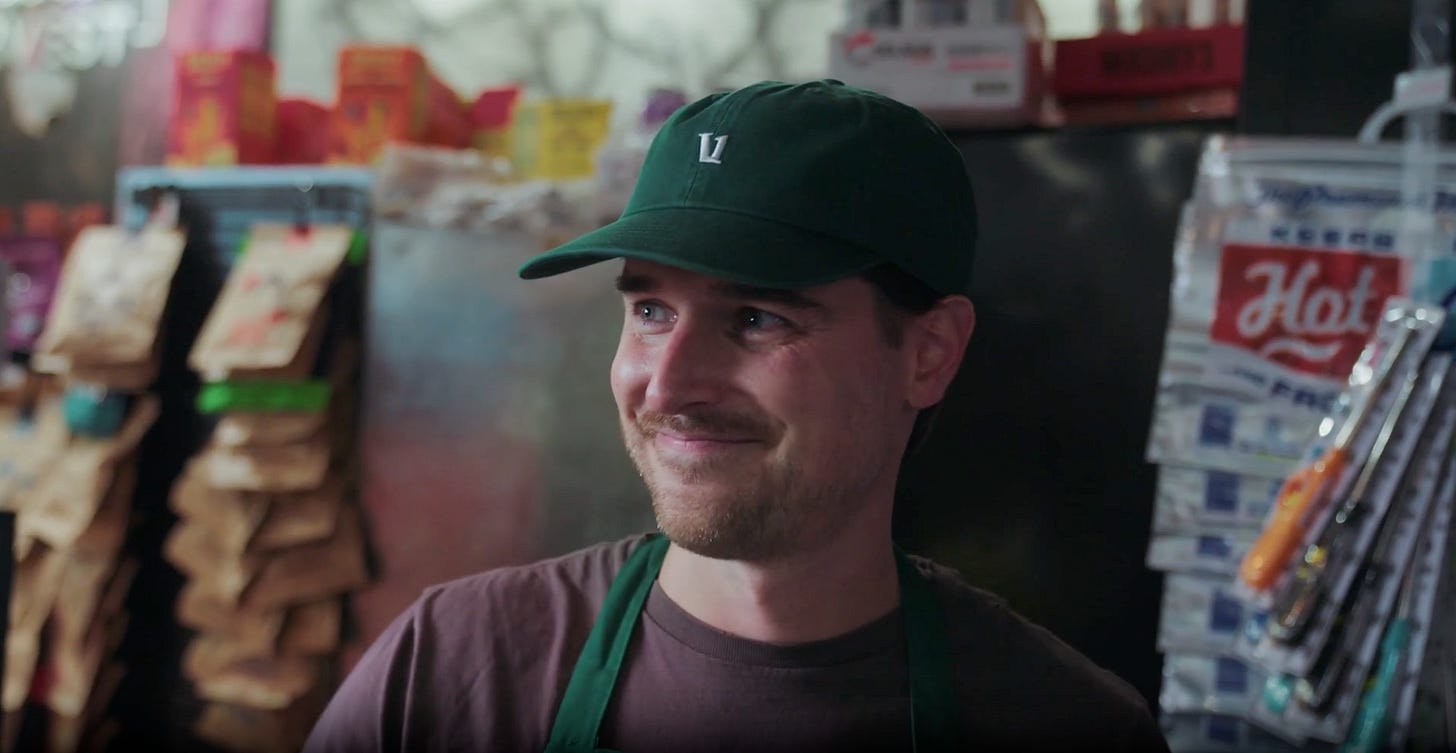
Clint and his co-founder Patrik had just raised $2M dollars and were looking to both make a big brand play and build pipeline from this video.
Clint needed the video to do certain things:
- Faithfully tell the Hazel story in a way that was on brand
- Build excitement and drive pipeline
- Return the budget
While I thought we could do all of these things, we had very little proof that we'd made anything go viral in the past.
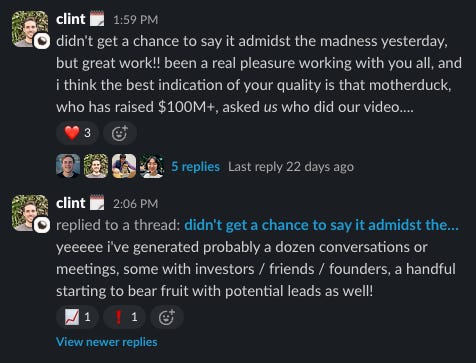
This was a big investment and I was clear with Clint on the size of the risk, given size of the production budget (just look at how much crew we had on set) and I'm forever grateful to Clint for taking a swing on us.
The client is also a creative
In addition to the commercial goals, l had strong creative opinions about the concept:
- Hazel should feel more like a human rather than a robot, and more like a coworker rather than a replacement
- The plot needed to feel like a real, relatable customer experience. Hazel serves marketers, and marketers sniff out bad marketing. I wanted the video to ooze with IYKYK so marketers would say “they get it”
- The video needed to feel timeless. I didn’t want another founders-on-the-couch-humble-bragging-their-raise.mp4. You only launch once — make it something future founders will look up on YouTube
And I’m grateful Clint was as great of a financial partner as he was a creative partner.
I’ll later learn that the success of a project depends on the taste of the CEO or the executive producer just as much as it depends on the director and the crew and we were lucky to have Clint on our first major project.
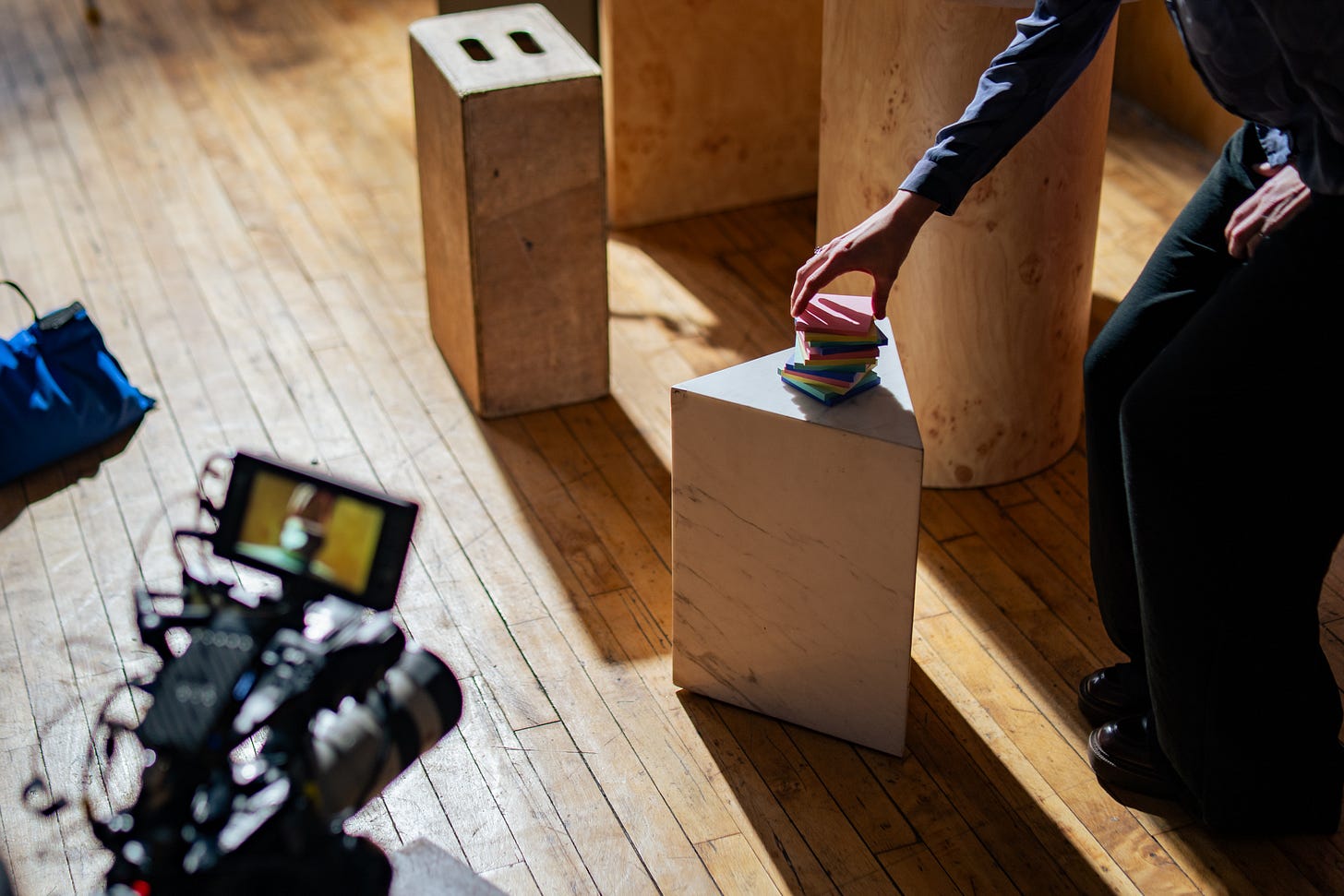
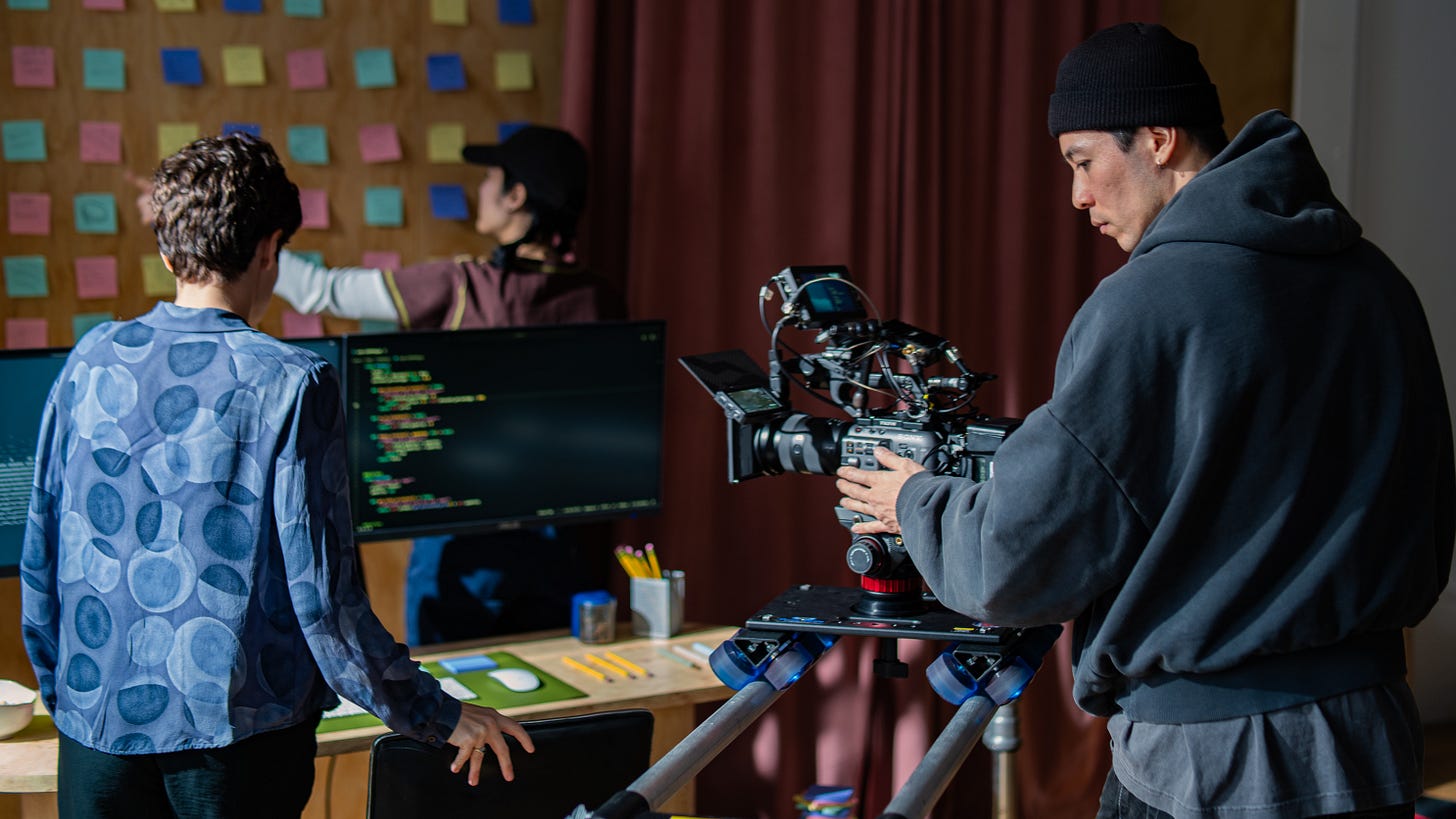
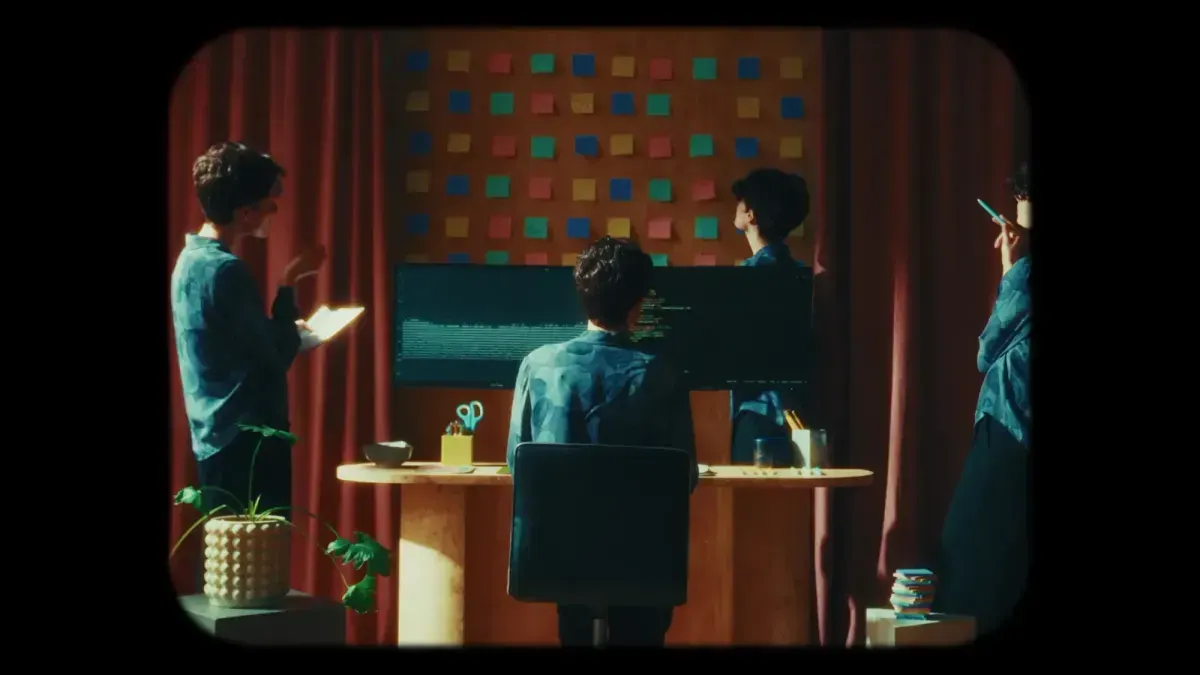
Here is the final launch announcement.
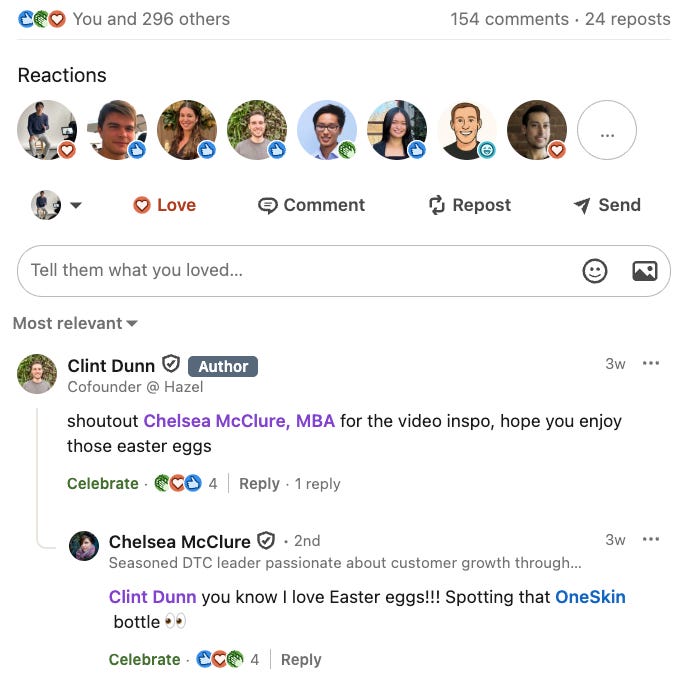
It turned out pretty well.
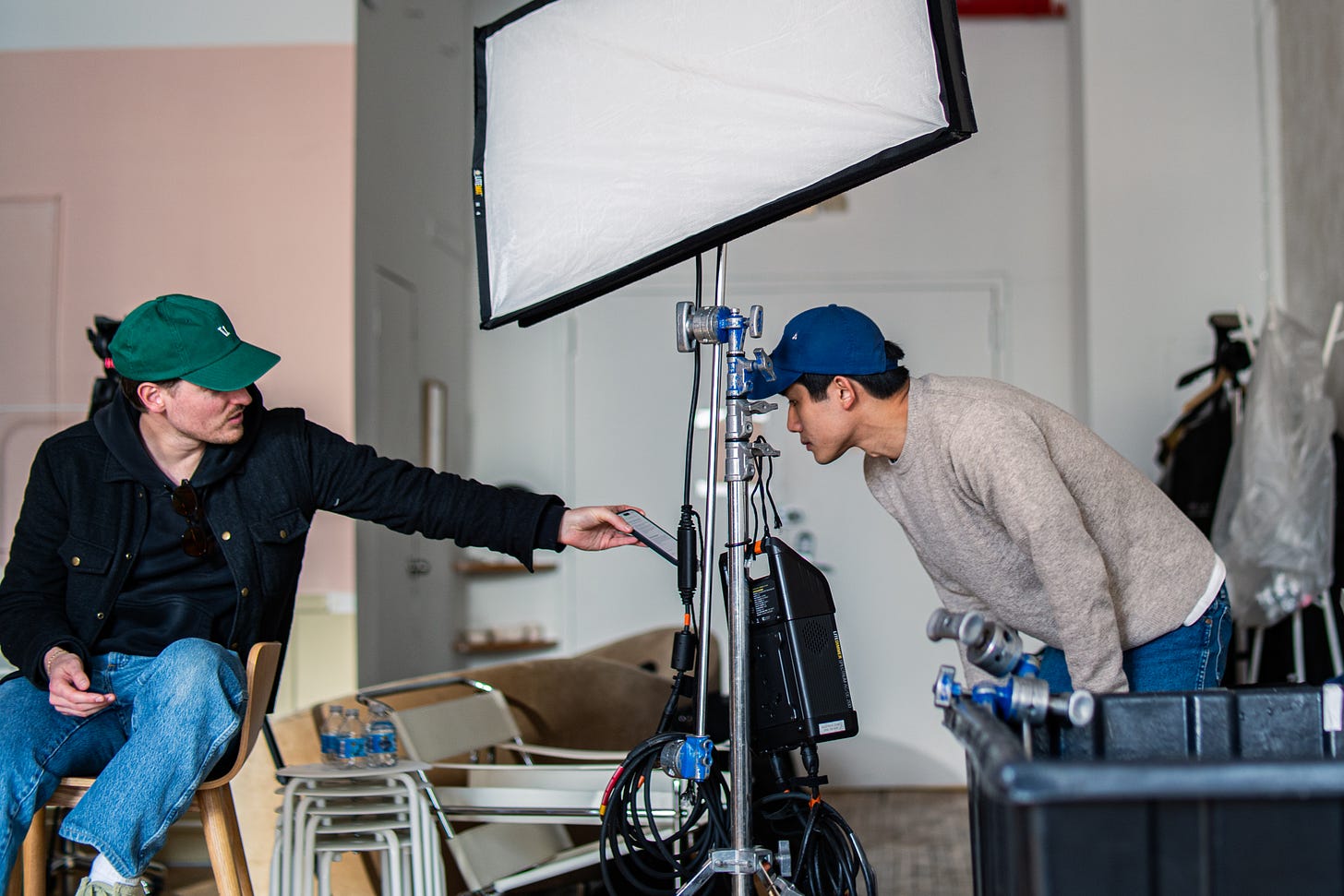
Cast and Crew
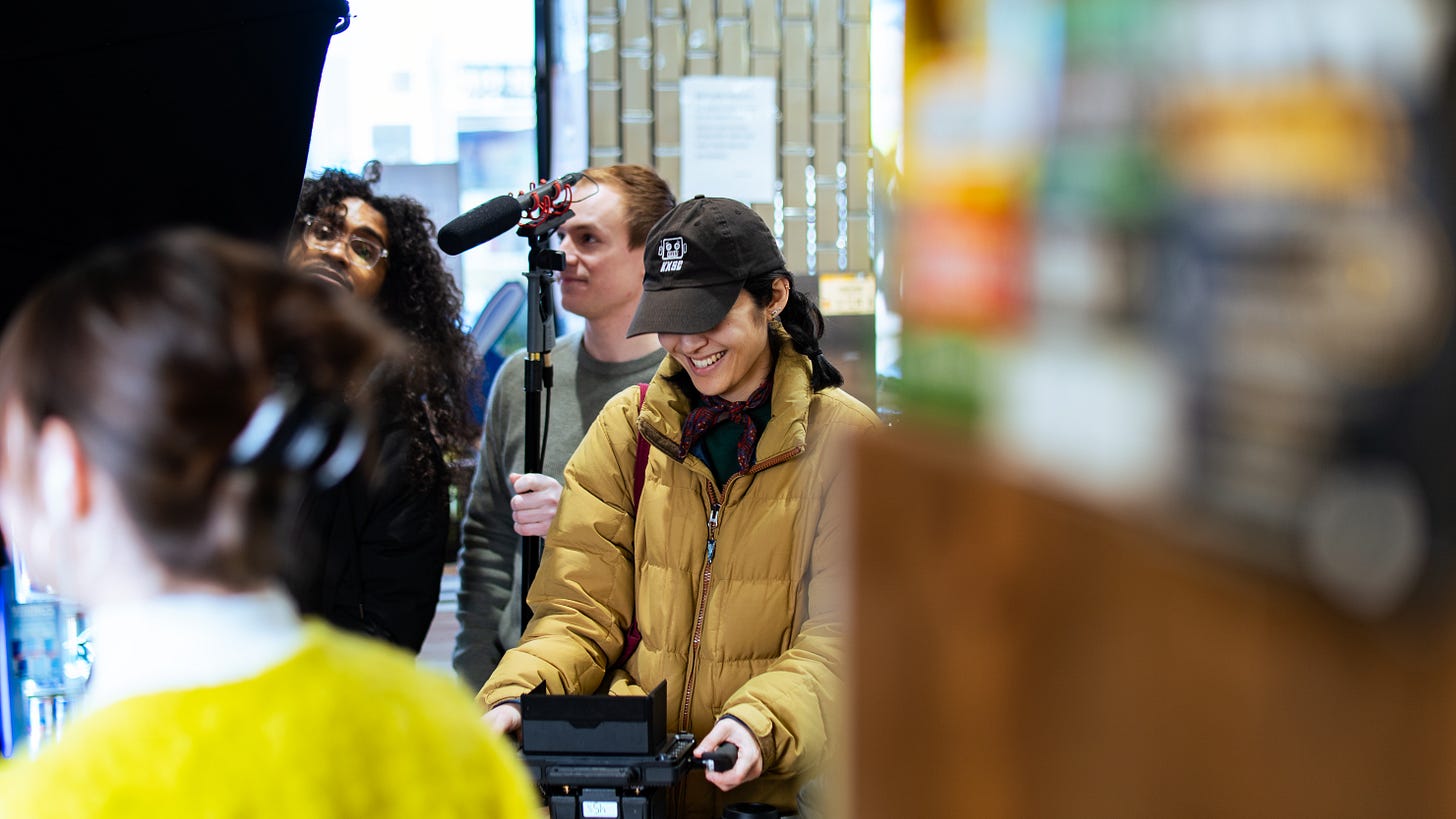
Founders: Clint Dunn and Patrik Devlin
Marketer: Rachel Newman
Hazel: Brooke Brazer
Cashier: Clint Dunn
Director: Hailey Choi
Producer: Jamie McNeill
Producer: Ira Ko
DP: Chiao Chen
Gaffer: Alexander Fischetti
Props: Hailey Choi
Production Assistant: Joohee Park
Post Production: Hailey Choi
VFX: Liam Walsh & Max Retik
Post Sound: Reid Andersen
Art Assistant: AJ Serrano
BTS Video: Anthony Hull
Hazel will return
I’m out of space for this email, but subscribe for Part 2, where I’ll share the BTS of the shoot and what I learned.